
Mutual Aid Resources Available in Alabama
Disclaimer
This website contains references and contacts. While data is reviewed for accuracy, NEMA is not responsible for out of date information. Please contact us with any suggestions for corrections.
Step 1: Understanding mutual aid options in Alabama
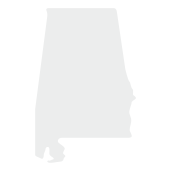
Intrastate Options: Mutual aid from within your state or territory
Intrastate mutual aid is a way for local governments like cities and counties to help each other during emergencies. It lets them share workers, equipment, and other resources. Some states also allow help from private companies and volunteers.
Alabama does not have a statewide program and instead utilizes individual agreements between local jurisdictions.
- This means: There is no known formal mutual aid system in this state, but individual jurisdictions can still create their own agreements to share resources
- Your state might also let cities and counties get help from private companies or volunteers for building department work after disasters
To learn more about how this works in your state, contact your state emergency management agency.

Interstate Options: Mutual aid from other states or territories through the Emergency Management Assistance Compact (EMAC)
EMAC is an agreement among U.S. states, territories, and the district that allows them to share resources and personnel during disasters or emergencies.
It helps states manage large-scale emergencies that exceed their individual capacities. Alabama has been a member of EMAC since 2001 which covers:
- Sharing of resources and personnel from other EMAC Members to perform response and recovery functions
- Tort liability and immunity protections when acting in good faith
- Guarantee of reimbursement for mission related, eligible, documented expenses

International Options: Mutual aid from Other Countries
Alabama is not a member of one of the international mutual aid agreements (PNEMA, IEMAC, nor NEMAC).
Step 2: Mutual Aid Contacts in Alabama
The next step is to connect with emergency management agencies and staff in your state, local, tribal or territorial location.
County or regional aid networks
How can they help
- Start at the local level by reaching out to your county emergency manager
- They are often your first point of contact for disaster response and recovery coordination
- A local emergency manager is often aware of the unique regulations for their community and may have connections to quickly mobilize regional mutual aid networks
Contact your local emergency network
Alabama County Emergency Managers
View local emergency manager contact list
If you can't find information for your location, check the State Emergency Management Agencies section of this page for more details about how to contact your state’s emergency management agency.
State Emergency Management Agency
How can they help
- Each state has its own emergency management agency that oversees disaster response and recovery efforts
- Coordinating with a state agency can help ensure the response and rebuilding is coordinated, occurs safely, efficiently, and in compliance with codes and regulations
- Many states and territories have laws and agreements in place that provide mutual aid only accessible through the emergencny management agency
Contact your state emergency management agency
Alabama Emergency Management Agency (AEMA)
Visit your state emergency agency's website
If your state emergency management agency is not able to assist you with your mutual aid needs, consider reaching out to one of the contacts listed in Step 3: Other mutual aid resources shown below.
State Hazard Mitigation Officer (SHMO)
How can they help
A state hazard mitigation officer can help identify funding opportunities.
SHMOs are key figures in coordinating hazard mitigation efforts and managing related grant programs.
A state hazard mitigation officer can also facilitate connections with other jurisdictions for mutual aid, provide guidance on developing effective agreements and protocols, and offer training and exercise support to improve readiness.
Floodplain Coordinator
How can they help
If your community has experienced flooding, you should also consider reaching out to a local floodplain manager.
National Flood Insurance Program (NFIP) Coordinators can provide valuable assistance for flood-related mitigation and recovery efforts.
State floodplain coordinators are responsible for statewide coordination of floodplain management and flood prevention activities including the National Flood Insurance Program (NFIP).
Contact your state floodplain coordinator
Alabama NFIP Coordinator Corey Garyotis, PE, CFM
Phone: 334-353-0853
Email: [email protected]
Step 3: Outreach for Education and Information
Emergency Management Assistance Compact (EMAC)
The Emergency Management Assistance Compact (EMAC) is the nation’s premier mutual aid system, providing a legal and operational framework for states to share resources during disasters. All 50 states, the District of Columbia, and U.S. Virgin Islands, Puerto Rico, Guam, and Northern Mariana Islands are members, ensuring rapid, flexible support across jurisdictional lines.
Each EMAC Member has a designated EMAC Coordinator who manages requests and offers of assistance, ensuring resources are deployed efficiently and in compliance with legal, logistical, and reimbursement requirements.
EMAC stands as a proven model of state-to-state cooperation during times of crisis. Learn more about EMAC.
International Code Council (ICC)
Assistance provided:
- Permitting and building code assistance
Group details:
- The International Code Council (ICC) is a nonprofit association that is focused on building safety worldwide. The ICC can provide skilled volunteers to assist local building department officials with building inspections and code enforcement in the aftermath of a disaster.
Regional Manager
Alexis Kyman
Email: [email protected]
Association of State Floodplain Managers (ASFPM)
Assistance provided:
- floodplain management, flood hazard mitigation, National Flood Insurance Program, and flood preparedness, warning, and recovery
Group details:
- The Association of State Floodplain Managers (ASFPM) and nearly 40 state chapters can provide communities with expert assistance in handling floodplain management responsibilities, conducting damage assessments, and offering guidance on code-compliant reconstruction after a natural disaster.
Alabama Association of Floodplain Managers (AAFM)
State chapter of the Association of State Floodplain Managers (ASFPM)
How they can help:
- State ASFPM chapters are a very good resource after a major event.
- In some cases, the state chapters themselves can provide and/or coordinate mutual aid assistance.